
Onboarding a new marketer, how to give them a fighting chance
Recruiting a new marketer is often accompanied by a great deal of optimism. Finally, someone who can take ownership of marketing, build campaigns, generate opportunities and relieve some of the pressure on the CEO or commercial director.
And then reality intervenes…
The new person spends their first few weeks finding their feet, getting to know the business, asking questions and trying to work out where to start. Meanwhile, the leadership team is wondering when the leads are going to arrive.
We’ve seen this scenario more than a few times in growing technology businesses. Particularly those where marketing has previously been managed by the founder or sales director, and delivered through a collection of external agencies.
The problem isn’t necessarily the person you’ve recruited. More often, it’s the assumption that a good marketer will arrive knowing what needs to be done and have everything they need to get on with it.
Even an experienced marketer needs to understand where the business is going, who its most valuable customers are, why they buy and what commercial infrastructure is already in place.
If the strategy is unclear, the proposition poorly articulated or the systems and processes inadequate, a new recruit can spend months trying to piece things together before they can make a meaningful contribution.
Good onboarding is about much more than familiarisation. It’s about giving someone the commercial context, relationships, resources and confidence to contribute to growth.
Whether you’ve recruited your first marketing executive or are bringing an experienced marketing manager into an established team, here are ten things worth considering if you want them to get up to speed and start making a difference.

Define: Help them understand your business and where growth will come from
Before someone can market a business effectively, they need to understand it. Not just what it sells, but how it makes money, what customers value and where the opportunities for growth lie.
This sounds obvious, but it’s surprising how often new marketers are introduced to the products, the website and the sales team without anyone properly explaining the commercial strategy.
1. Explain how your business makes money
Give your new marketer a proper introduction to the business model.
How does revenue flow through the organisation? What are the most profitable products or services? Which customers contribute most to growth? What does a typical customer relationship look like over time?
In technology businesses, particularly those with recurring revenue models, it’s important to understand the distinction between winning new customers, developing existing accounts and retaining the ones you already have.
Marketing has a role to play across all three, but the priorities and measures of success may be very different.
Don’t assume that someone who understands marketing automatically understands your commercial model. Help them see how their contribution connects to the wider business.
2. Share your growth strategy and commercial objectives
What is the business trying to achieve over the next twelve months?
Where is growth expected to come from? New customers, existing accounts, new markets, new services or a combination?
Your marketer needs to understand the commercial priorities before deciding which marketing activities deserve attention.
If you have a documented growth strategy, share it. If you don’t, this might be a useful moment to recognise that one is needed.
It’s also worth explaining the numbers. Revenue targets, sales pipeline, average deal values, conversion rates and sales cycles all provide context for what marketing needs to achieve.

3. Explain who your ideal customer are and why they buy from you
One of the most useful things you can give a new marketer is a clear understanding of your ideal client profile, your competitive position and your value proposition.
Who are the customers you most want to attract? What problems are they trying to solve? Why do they choose you rather than a competitor or simply doing nothing?
There’s an important distinction between understanding what your products do and understanding why customers buy them.
If your new marketer is expected to develop campaigns, create content or generate demand, they need to know which audiences matter and what messages are likely to resonate.
And if the business hasn’t properly defined its ideal customers or what makes it different, don’t expect the new recruit to work it all out independently while simultaneously delivering a full marketing programme.
These are fundamental questions that sit at the heart of a good growth strategy.
Eventually, the onus will fall to them to build a deep understanding of the primary target sectors and how your propositions create value
4. Get them talking to customers and partners
Don’t leave your new marketer learning about customers entirely through internal presentations, CRM records and conversations with the sales team.
Arrange opportunities to speak directly with customers. Let them listen to sales conversations, join account reviews, meet key partners and hear first-hand why people choose your business.
Encourage them to ask questions. What challenges were customers trying to overcome? What alternatives did they consider? What surprised them about working with you? What would they tell someone else considering your services?
These conversations often reveal insights that don’t appear in the official marketing messages.
They also help a new marketer build relationships across the business and develop a more rounded understanding of the market.
In time, the new marketing manager should be proactively building relationships with customers and partners and feeding their own insights back to the business
Once your marketer understands the business and its commercial objectives, the next challenge is helping them turn that knowledge into action.

Build: Give the tools, relationship and resources to deliver
This is where the quality of your commercial infrastructure becomes important.
A capable marketer can achieve a great deal, but they will struggle if they have to spend their first six months untangling systems, searching for information or discovering why previous campaigns didn’t work.
5. Explain what’s been done before and what you’ve learned
Share the marketing plans, campaigns, activities and results from the previous year or two.
What’s worked well? What hasn’t? What has the business invested in, and what did it learn? Are there campaigns worth repeating, relationships worth developing or content assets that could be used again?
Be open about the failures as well as the successes.
It’s frustrating for a new marketer to spend weeks developing an idea only to discover that the business tried something similar eighteen months earlier with disappointing results.
Equally, don’t dismiss an approach simply because it didn’t work before. Markets change, execution improves and circumstances may be different.
The important thing is to provide context so your new marketing manager can make informed decisions rather than start from scratch.
6. Introduce the digital ecosystem, processes and data
Most marketers inherit a collection of systems, platforms and processes that have developed over time. CRM, marketing automation, website analytics, email platforms, social media tools, advertising accounts and reporting dashboards may all form part of the picture.
Make sure your new marketer has the appropriate access, understands how the systems fit together and knows who is responsible for maintaining them.
More importantly, explain how the business manages the customer journey.
Where do enquiries come from? How are leads qualified and handed to sales? What happens next? How is pipeline attributed, and how does the organisation measure marketing’s contribution?
If the data is incomplete or the processes aren’t working particularly well, be open about that too.
A new marketer shouldn’t have to discover the limitations of the commercial infrastructure through trial and error.
Sometimes the most valuable early contribution they can make is identifying the gaps that need to be addressed before the business can scale its marketing activity.
This is a central part of building an effective commercial growth engine.
7. Build strong relationships with sales and the wider team
Marketing doesn’t operate in isolation, particularly in a business where sales cycles are long, buying decisions involve multiple stakeholders and customer relationships are commercially significant.
Introduce your new marketer to the people who can help them understand how business is won and retained.
That means spending time with sales, account management, customer success, technical specialists and anyone else who has valuable customer insight.
Encourage them to understand the sales team’s challenges. Where do opportunities get stuck? What objections come up repeatedly? What information would help move a prospect forward? What do the best customers have in common?
These relationships should be two-way. Sales needs to understand what marketing is trying to achieve and how it can contribute.
One of the most common sources of friction in growing businesses is the disconnect between marketing activity and sales priorities.
Good onboarding is an opportunity to establish a more joined-up way of working from the outset.
8. Give them access to the expertise and resources they need
Not every marketer can do everything. Nor should they be expected to.
Marketing now encompasses a very broad range of disciplines, from positioning and content development to data analysis, digital advertising, automation, website management and creative production.
A relatively junior marketing executive may be perfectly capable of coordinating campaigns and managing suppliers but lack the experience to develop a go-to-market strategy.
An experienced marketing manager may be commercially astute but need specialist support with search optimisation, technical integrations or creative work.
Be realistic about the skills you’ve recruited and the resources available.
Make introductions to existing agencies, freelancers and technology partners. Clarify budgets and decision-making responsibilities. Explain where external expertise can be brought in.
In smaller businesses, the new marketing manager may be the most senior marketer in the organisation. That can be a lonely position, particularly when they’re expected to advise the leadership team while also delivering day-to-day activity.
This is one situation where a Fractional CMO can be particularly valuable, providing experienced marketing leadership, helping establish priorities and supporting the new recruit as they develop their role.

Scale: Help them become productive and make an ongoing contribution to growth
Getting a marketer up to speed is one thing. Creating the conditions in which they can continue to contribute, develop and deliver measurable results is another.
It’s tempting to judge a new appointment by how much activity they generate in the first few weeks. But activity isn’t necessarily progress, and some of the most valuable early work may not be immediately visible.
9. Agree realistic objectives and give them a 90 day onboarding plan
A good onboarding plan should help both the employee and the business understand what to expect.
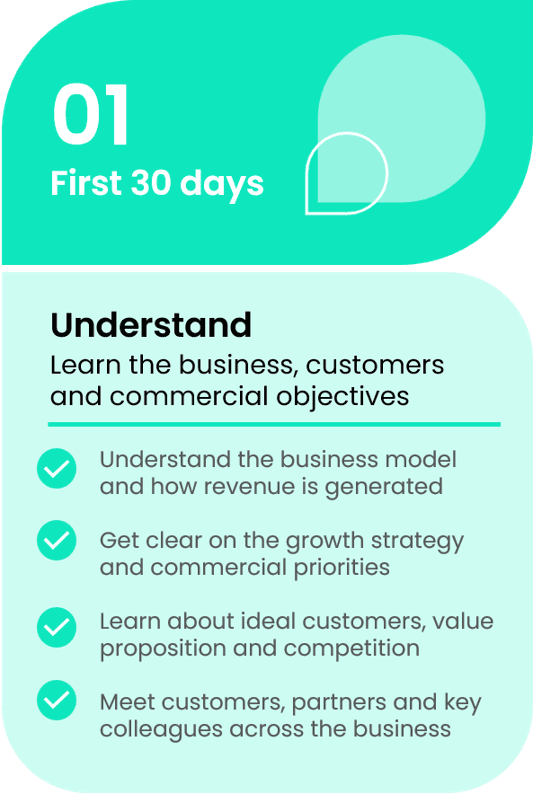
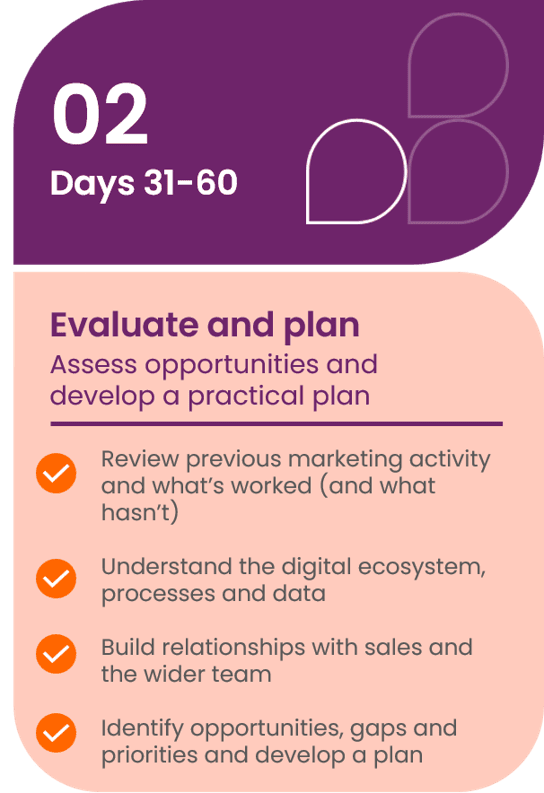
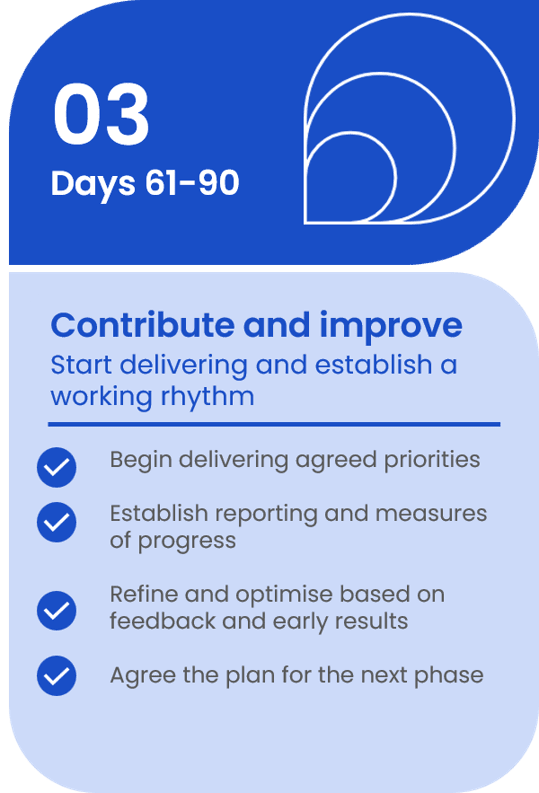
The first three months provide a useful framework, although the priorities will vary depending on the seniority of the role, the maturity of the marketing function and the commercial challenges facing the business.
| Period | Primary focus | What good looks like |
| First 30 days: Understand | Learn the business, customers, market, commercial objectives, systems and existing activity. | Can explain the proposition, priorities and customer journey. Has built relationships and identified questions or gaps. |
| Days 31–60: Evaluate and plan | Review existing marketing performance, assess opportunities, agree priorities and develop a practical plan. | Has a clear view of what to continue, improve or stop, with priorities aligned to commercial objectives. |
| Days 61–90: Contribute and improve | Begin delivering agreed priorities, establish reporting and develop a consistent working rhythm. | Activity is underway, early indicators are being measured and there is an agreed plan for the next phase. |
These aren’t rigid milestones. A senior marketer joining an established team may be expected to move much faster, while someone taking their first marketing role will need more guidance and support.
It’s also important to distinguish between measures of activity and measures of commercial impact.
Campaigns launched, content produced and website improvements completed may be useful early indicators. Qualified pipeline, customer acquisition and revenue contribution are ultimately more meaningful, but they often take longer to materialise.
Particularly in B2B technology businesses with lengthy sales cycles, expecting a new marketer to demonstrate a substantial revenue impact within ninety days may be unrealistic.
Agree what progress looks like, establish a sensible reporting cadence and review priorities together.
10. Provide leadership, mentoring and regular feedback
Perhaps the most important thing you can do for a new marketer is make sure they have someone to talk to.
Someone who can challenge their thinking, help them navigate internal politics, make decisions about priorities and provide constructive feedback.
This matters at every level, but particularly for marketers working in businesses without a senior marketing leader.
A CEO or commercial director may be an excellent source of commercial insight without necessarily having the time or specialist experience to mentor someone across the full range of marketing disciplines.
Regular conversations about what’s working, what’s proving difficult and where support is needed can make an enormous difference.
Encourage your marketer to question established assumptions and bring new ideas to the table. After all, part of the value of recruiting someone new is the fresh perspective they bring.
And remember that onboarding isn’t something that ends after the first week, or even the first three months. As the business develops, priorities change and the marketer’s responsibilities evolve.
Creating a culture of learning, accountability and constructive challenge will help them become more effective over time.
Give your new marketer a fighting chance
Recruiting a marketer can be an important step in the development of a growing business. It’s often a sign that the organisation recognises the need for a more structured, consistent approach to customer acquisition and growth.
But recruitment alone won’t address the growth challenges.
If the business lacks a clear proposition, an agreed commercial strategy, effective processes or the right supporting resources, even a very capable marketer may struggle to deliver what’s expected.
In fact, a new appointment can sometimes expose weaknesses in the organisation that were previously hidden by the efforts of the founder or a small number of experienced individuals.
That’s not necessarily a bad thing. Recognising those gaps is often the first step towards building something more sustainable.
At ReStrategy, we think about growth in three connected stages: Define where and how the business can compete, Build the commercial engine needed to deliver, and Scale by developing the alignment, capabilities and performance culture that make growth more predictable.
The same principles apply when bringing new people into the team.
Give them clarity about where the business is going, the infrastructure and resources to do their job, and the leadership and support to keep improving.
Then give them the opportunity to make a difference.
How ReStrategy can help
If you’re building your marketing capability, introducing a new marketing manager or finding that your existing team needs more strategic direction, ReStrategy can help.
Our Fractional CMO service brings experienced commercial marketing leadership into the business, helping to align strategy, people, processes and execution.
That might mean establishing a marketing plan, strengthening the commercial foundations, developing the team or providing hands-on leadership while your new marketer finds their feet.
Explore our Fractional CMO service to see how we can help your marketing team get up to speed and contribute to growth.
Frequently Asked Questions
How do you onboard a new marketing manager?
Start by giving them a clear understanding of the business model, commercial objectives, ideal customers and value proposition. Introduce them to sales, customers and key colleagues, provide access to existing systems and plans, and agree priorities for their first 90 days. Good onboarding should establish both the context and the practical support they need to succeed.
What should a new marketer do in their first 30 days?
The first month should focus primarily on understanding the business rather than rushing into new campaigns. That means meeting colleagues and customers, reviewing existing marketing activity, learning how the commercial systems work and understanding the sales process. By the end of the month, they should be able to identify early opportunities, important gaps and areas that need further investigation.
How long does it take a new marketing employee to become productive?
It depends on their experience, the complexity of the business and the support available. An experienced marketer joining a well-organised team may contribute almost immediately, while someone entering a new sector or an immature marketing function will need longer. A 90-day onboarding plan provides a useful structure, but meaningful commercial results may take several months, especially where sales cycles are long.
What should be included in a marketing onboarding plan?
A useful marketing onboarding plan should cover the business strategy, products and services, ideal customer profiles, competitive positioning, commercial targets, existing marketing activity, technology systems, data, key relationships and performance expectations. It should also identify who will provide guidance, what resources are available and how progress will be reviewed.
How do you set realistic KPIs for a new marketing manager?
Start with the commercial objectives and consider what the marketer can reasonably influence. Early measures might include completion of a marketing audit, agreement on priorities, campaign implementation, improvements to data quality or establishing reporting. Over time, the emphasis should shift towards qualified opportunities, pipeline contribution, customer acquisition and other commercial outcomes. The measures should reflect the role, available resources and length of the sales cycle.
Who should manage a marketer if the business doesn’t have a marketing director?
A CEO or commercial director can provide commercial direction, but may not have the time or specialist expertise to offer day-to-day marketing leadership. In these circumstances, an experienced fractional CMO or marketing mentor can provide strategic guidance, help establish priorities, support professional development and ensure marketing activity remains aligned with business objectives.